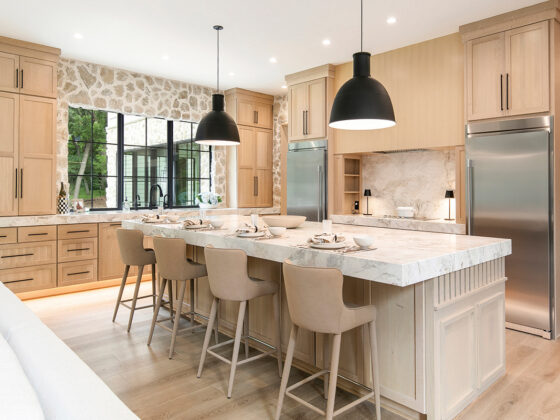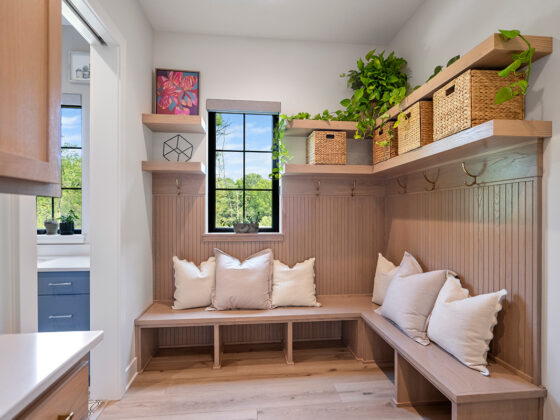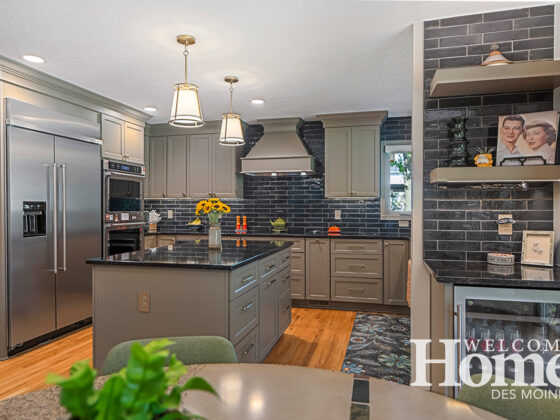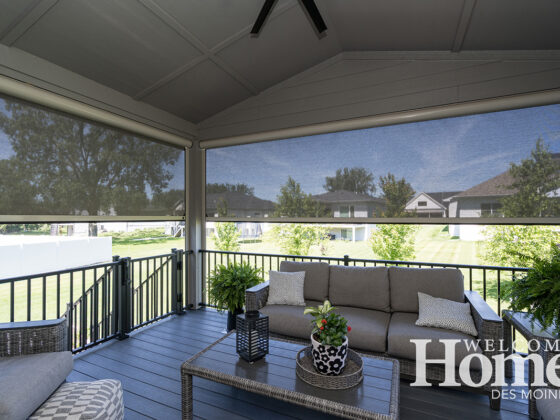

Lighting options are even more eclectic than ever.
Story by Tracy Dickinson
Featured in Autumn 2025
Unlike choosing furnishings, paint colors, and decor, updating your home’s lighting is rarely a decision based on the latest trends. Fortunately, if you’re in the market for new lighting or planning the fixtures for your new home, right now is a good time to be looking.
“There isn’t really a single trend in lighting,” says Amy Kimberley of Ferguson Home. “Styles are all over the board, so you can find something to fit whatever suits you and your home.”
Because nearly anything goes, professionals offer some advice for creating the best lighting plan for your home.
Know your space
Amy Kalkworf of Echo Lighting says, “Most homeowners haven’t had to think about lighting other than styles that they like. Part of our job is to help them understand how their space affects the decision, especially the size of fixture that will be best.”
Despite online images that might lead you to think otherwise, chandeliers are not ideal in every situation. If your home’s ceiling is less than 9 feet in height, most chandelier-style fixtures will be too large for your space.
“In a dining room, when the fixture will be hung over a table, chandelier types of fixtures are great,” says Echo’s Erin Huisman. “That’s one of the places where a statement piece works well. But putting in a chandelier with lower than 9-foot ceilings will make the ceiling actually feel lower and the space feel smaller.”
Another factor to consider is the line of sight within your space. “If you have a really open plan, where the line of sight extends all the way from the front entry to the family room, it can feel cluttered to have hanging fixtures in the entry, over the stairs, and in the family room, too,” says Kim Shore of Echo. “It can depend on the size of the space, but you want to take that into consideration when you’re making those selections.”
Know your terms
Also important is making sure you and your designer are speaking the same language.
“There are a lot of terms that mean different things to different people,” says Shore. “Contemporary, coastal style, modern farmhouse—those terms can describe a lot of different styles. We always encourage people to bring pictures of their home or of things that they like so that we’re picturing the same thing they are.”
Understanding the differences among recessed, track, pendant, flush-mount, ambient, task, accent, and decorative when those terms describe lighting will make your conversations easier as well.
“We’re seeing a lot more fixtures with natural materials such as wood, fabric, and rattan. And exposed bulbs are popular too.”
Amy Kalkworf, Echo Lighting
Even a basic understanding of some of the technical lighting terms will aid your decision-making. Fixtures that use bulbs will have a different appearance depending on the style and warmth of the bulb you choose. And some fixtures that have integrated LED lights offer color-changing technology (CCT), while others are set to a particular Kelvin (color temperature).
“Most LED fixtures are in the 3000 to 3500 Kelvin range, which is closer to natural light,” says Kimberley. “The higher the number, the harsher the light can appear. And if you get down to 2700 or lower, the light can be too warm.”
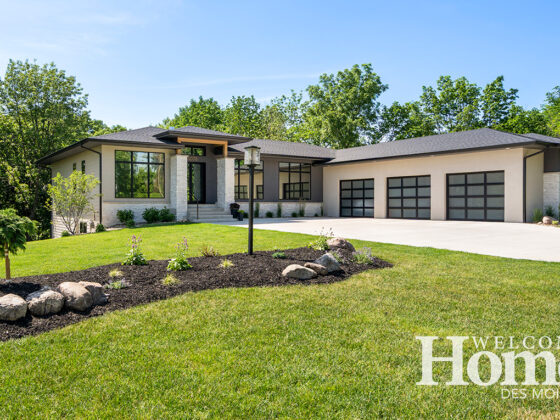
She says another factor that homeowners often forget is outside lighting. Although most of the exterior lighting is specifically placed for security and accent, the lights on the front of the house should be both decorative and functional.
“Having a picture of the front elevation is helpful. And knowing the mounting surface and measurements for placement is really important,” Kimberley says. For example, mounting on brick or stone might require a different process than mounting on siding.
Know your style
Once you’ve defined your terms and you have an idea of the types of fixtures your space demands, gather some pictures to create your own personal mood board of such elements as styles, finishes, and colors.
“We’re seeing more of the old-style fixtures again with distressed finishes, hammered metals, even a lot more ceramic and glass,” Kimberley says.
“For a while, decor was all grays and black,” Shore says. “But everything is softer now, colors and finishes both.”
As paint and fabric trends softened to neutrals and natural textures, lighting trends followed.
“The brass and black finishes are softer, too,” says Huisman. “Champagne bronze is popular, and we’ve seen a bronze-type finish that’s nearly black.”
Kalkworf says, “We’re seeing a lot more fixtures with natural materials such as wood, fabric, and rattan. And exposed bulbs are popular too.”
“Most homeowners won’t change their fixtures unless they do a remodel,” Kimberley says. “And fixture styles can last as much as a decade. So even a statement piece should be somewhat classic. You’re probably going to be living with it for quite a while.”
When it comes to selecting your home’s lighting, don’t let trends have the final say. Take a good look at the space, assess the types of fixtures that are best suited to your needs, and look for fixtures that you’ll love for years to come. Whatever “classic” means to you, there’s a fixture for that. •
Resources
- Erin Huisman Echo Lighting
- Amy Kalkworf Echo Lighting
- Amy Kimberley Ferguson Home
- Kim Shore Echo Lighting