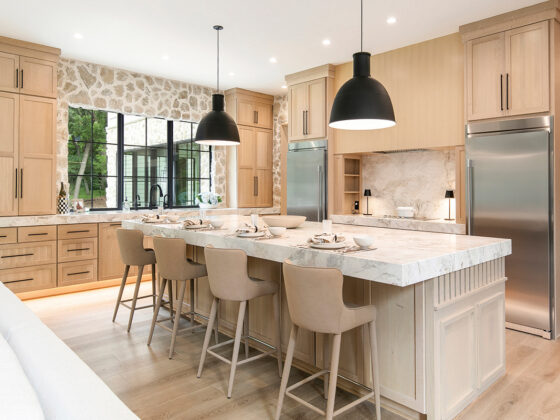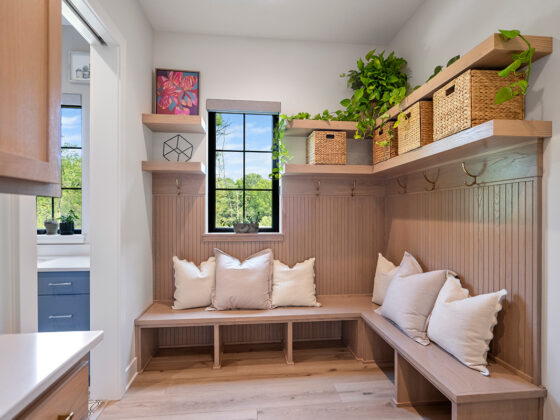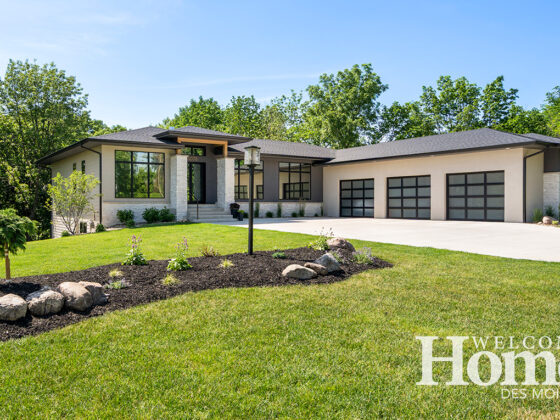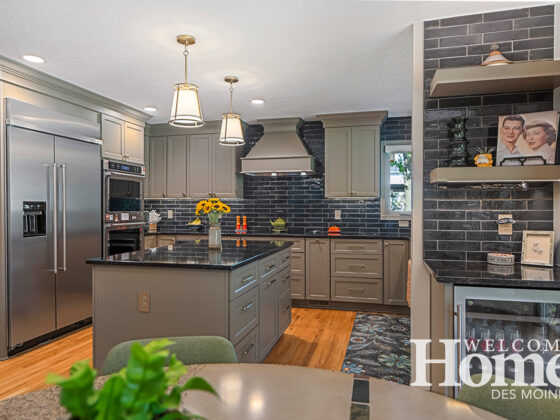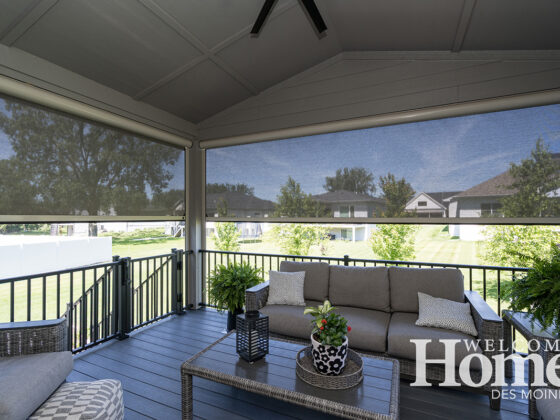

Trends in home design reveal modern priorities.
Story by Tracy Dickinson
Photography by Mirza Kudic
Featured in Winter 2026
Typically, a home’s era can be easily identified by a few key elements. Victorian styles with high, narrow windows and a central hallway are indicative of the early 1900s. By the 1950s, the burgeoning suburbs and the benefits of the GI Bill resulted in the popularity of the ranch-style home. The 1990s McMansions boast of a supposedly thriving economy, where the key philosophy was “bigger is better.”
As we complete the first quarter of the 21st century, perhaps the dominant factor driving home trends is cost. The price of land has resulted in smaller lot sizes, which has led to smaller footprints for most new homes. And the cost of construction has caused homeowners to prioritize finish features that will most enhance their quality of life.
Looking ahead and looking at changes over the past few years, home designers say there are some clear trends in home plans.
Bigger isn’t necessarily better
According to Kevin Riesberg of the Riesberg Group, “In my experience over the last few years, I haven’t seen a lot of smaller custom homes, but the larger custom homes we’re designing have been dialed back in square footage. Overall construction cost is playing a role in that. The customer would likely build bigger if costs were lower.”
Beisser Lumber’s Amy Larsen agrees. “Our projects tend to be at the two ends of the spectrum: homes at 2,400 square feet and up or less than 1,600 square feet. We’re missing that middle segment at the moment with new homes. But we are seeing more remodel projects that include additions of primary suites or four-season and outdoor living spaces. People are adapting their space to fit their needs rather than building a new home, and I’m guessing much of that activity is being driven by price.”
“In my experience over the last few years, I haven’t seen a lot of smaller custom homes, but the larger custom homes we’re designing have been dialed back in square footage. Overall construction cost is playing a role in that.”
Kevin Riesberg, Riesberg Group
To accommodate smaller lot sizes, both Riesberg and Larsen say they’re designing more 1½- and 2-story homes than they had in recent years.
“The ranch style is still very popular,” says Riesberg, “but as custom homes get larger, I’ve seen more homeowners lean toward 1½- and 2-story designs.”
Larsen says, “Our 2-story projects have been for custom or built-to-order clients. In the spec market especially, our main focus is still ranch plans. A number of our builders have transitioned to smaller ranch plans in the outlying communities so they can keep their homes more affordable to homeowners.”
Efficiency matters
Although many styles remain popular, including modern farmhouse, Craftsman, semi-contemporary, or the growing trend toward modern mountain style, all of them have a common focus: getting the most out of the square footage.
No matter what the home size, features such as higher ceilings, walk-in pantries, and large garages are almost nonnegotiable.
“Having taller ceilings on both the main level of the home and the lower level has become a priority,” says Riesberg. “And a walk-in pantry is a must. This can be bigger as budget allows, but most homeowners want some sort of walk-in pantry.”
Although open plans are still most common, both Larsen and Riesberg say home designs are trending toward semi-open layouts, which accomplishes two things. Not only does this layout help define spaces more effectively, but it creates opportunities for built-in storage, making the space more efficient.
“We’re seeing a lot of situations where the plan is focused on staying in the home longer, being able to age in place.”
Amy Larsen, Beisser Lumber
Make it personal
Since few homeowners are operating on a sky’s the limit budget, bonus features and finish choices are also being prioritized, much like layout decisions are. Custom home plans are by no means basic, but the features are very specific to the client.
“Often, rooflines are efficient, not complicated, and we’re focusing on clean finishes to help keep costs down,” says Larsen. “But homeowners are spending money where it matters to them, for instance for a spacious walk-in pantry, a larger garage, outdoor living space, an area for a golf simulator.”
Riesberg says, “Outdoor living space is highly desired, along with workout spaces that include a sauna and wellness area. Main-floor primary suites with a soaking tub and larger walk-in shower are also popular.”
Custom home plans are also frequently designed with the future in mind as much as the present.
“We’re seeing a lot of situations where the plan is focused on staying in the home longer, being able to age in place,” Larsen says. “Features that make that possible are really popular right now: zero-entry garages, wider doors, main-floor primary suites with laundry.”
“In-law suites for aging parents are growing in popularity, too,” says Riesberg.
Larsen says that she would not be surprised to see more multigenerational homes in the future. “We’re already seeing more mother-in-law apartments,” she says. “But a multigenerational design enables the grandparents to be on hand to help raise the grandchildren, or it allows the adult children to care for aging parents at home.”
Like the 1950s ranch, the turn-of-the-century Victorian, and the McMansion, in another 25 years, the multigeneration home might be a hallmark of our time. One thing is certain—the home of today is being designed with tomorrow in mind. •
Resources
- Amy Larsen Beisser Lumber
- Kevin Riesberg Riesberg Group