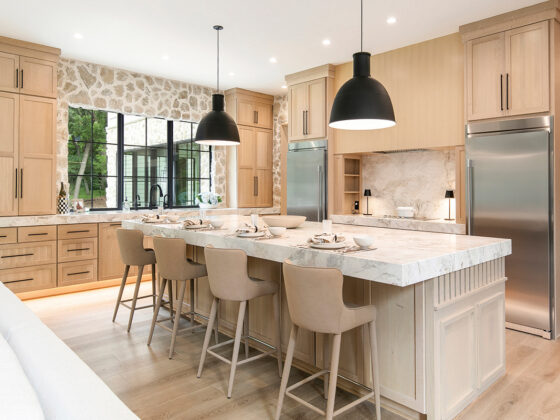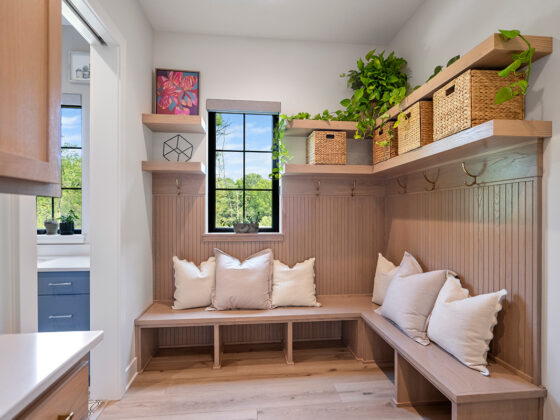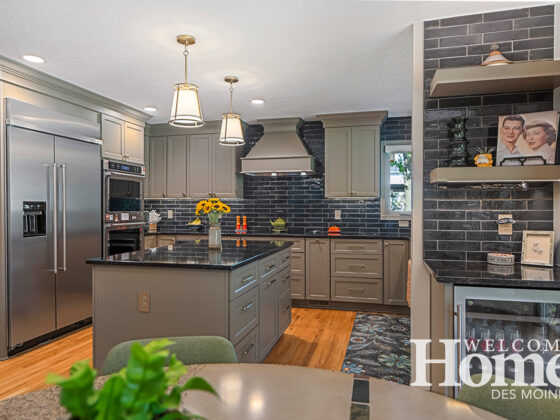

Blending beauty and function, kitchen islands remain at the heart of the design.
Story by Tracy Dickinson
Photography courtesy Kimberley Development
Featured in Summer 2025
The kitchen may be the heart of the home, but the heart of the kitchen can be the island. Whether it’s the focal point of the design or the center of the workspace, everything tends to revolve around the island.
Moehl Millwork’s Will Hipwell says, “Islands are no longer just for prep. They’re dining tables, workstations, beverage centers, and storage hubs.”
Multipurpose doesn’t mean merely functional. Whatever its primary function, today’s kitchen island can still stand out as a thing of beauty.
Focal Point
Statement islands remain popular no matter the size, but large islands are becoming more common.
Tina Noel of The Kitchen & Bath Company says, “When I originally started designing kitchens years ago, islands were typically 3 or 4 feet long. Now it’s common to have an 8-foot island, and we can easily go up to 16 feet if the space in the room accommodates it.”
“In larger kitchens we’re seeing either double islands—one for prep and one for entertaining—or extra-long islands that can seat six or more and offer multiple functional zones,” Hipwell says.
Woodharbor’s Jammie Pekarek says color is still a key element in island design. “Two-toned countertops are still in, whether it’s a mix of quartz and butcher block or two different-color quartz, quartzite, or granite materials. The different colors help define the different functional areas such as dining, prep, and others.”
Although furniture-style islands are declining in popularity, contrasting cabinetry continues to define island design.
“When I originally started designing kitchens years ago, islands were typically 3 or 4 feet long. Now it’s common to have an 8-foot island, and we can easily go up to 16 feet if the space in the room accommodates it.”
Tina Noel, The Kitchen & Bath Company
“Contrasting island cabinetry and countertops, like dark walnut-base cabinets with a light quartz countertop, create a bold focal point,” Hipwell says. “We’re seeing natural wood tones like walnut or white oak paired with stone or solid-surface tops for a warmer, more organic vibe. We’re also seeing dramatic contrasting colors like navy-, forest green-, or black-painted base cabinets with white or light quartz countertops.”
Although Woodharbor is implementing fewer contrasting island designs, Trish Connor says, “It’s nice to see a beautifully patterned waterfall granite countertop on a simple island with blonde flush doors. It’s a very Zen look.”
Work Center
No matter what the style, the kitchen island is designed to be a key workstation, and that is the primary driver in its design.
Hipwell says, “We’re often designing islands with larger integrated work surfaces and integrated appliances.”
Noel says, “Islands can be designed to include everything from pull-out trash receptacles and spice storage to pop-up mixer shelves, microwaves, and sinks.”
Because the island functions as food prep station, dining area, and service area, designers and manufacturers are offering size-appropriate beverage coolers, cabinetry with microwave drawers, and even downdraft cooktops suitable for island applications.
Hipwell says, “Cabinet technology often shapes island function. Homeowners expect soft-close everything. With the availability of internal organizers like knife blocks, spice racks, and roll-out trays, the island has become more functional than ever.”
“Oversized islands without the separate dining space give the homeowner more workspace while still creating a connection with the family seating area,” says Noel. “Seating can be on the back side of the island or on the end with storage still available below if you prefer.”
Show stopper
Even when the island isn’t designed as the focal point of the kitchen, it can include some showstopping features.
“Clutter-free islands are trending,” says Connor. “This style is typically one level and free of sinks or appliances on top. I’ve even designed an island with a concealed induction cooktop.”
Noel says, “One of my favorite designs was an island with one large slab of stone for the surface. That can be really dramatic when you walk into the room. Adding waterfall ends on both sides carries the veining in the stone as it drops down the sides, too.”
Those oversized islands are ideal for homeowners who like to entertain. “We did an L-shaped island that maximized seating while still leaving a wide central walkway,” says Hipwell. “The homeowners then had more seating, more prep surface, and better traffic circulation than they would have had with a traditional rectangular island.”
The local design professionals also emphasize the importance of a lighting plan, not only to make the most of the island’s design but also to improve its functionality. “Task lighting under the cabinets, toe-kick lighting at the island base, and dimmable ambient lighting overhead all enhance the island’s design and function,” Hipwell says. “Layering the lighting this way and doing so with stylish fixtures makes its own statement.”
Ultimately, island design is a reflection of the way we like to live our lives—gathering together with those we love. And the kitchen is usually at the heart of that. •
Resources
- Tina Noel The Kitchen & Bath Company
- Will Hipwell Moehl Millwork
- Trish Connor Woodharbor
- Jammie Pekarek Woodharbor